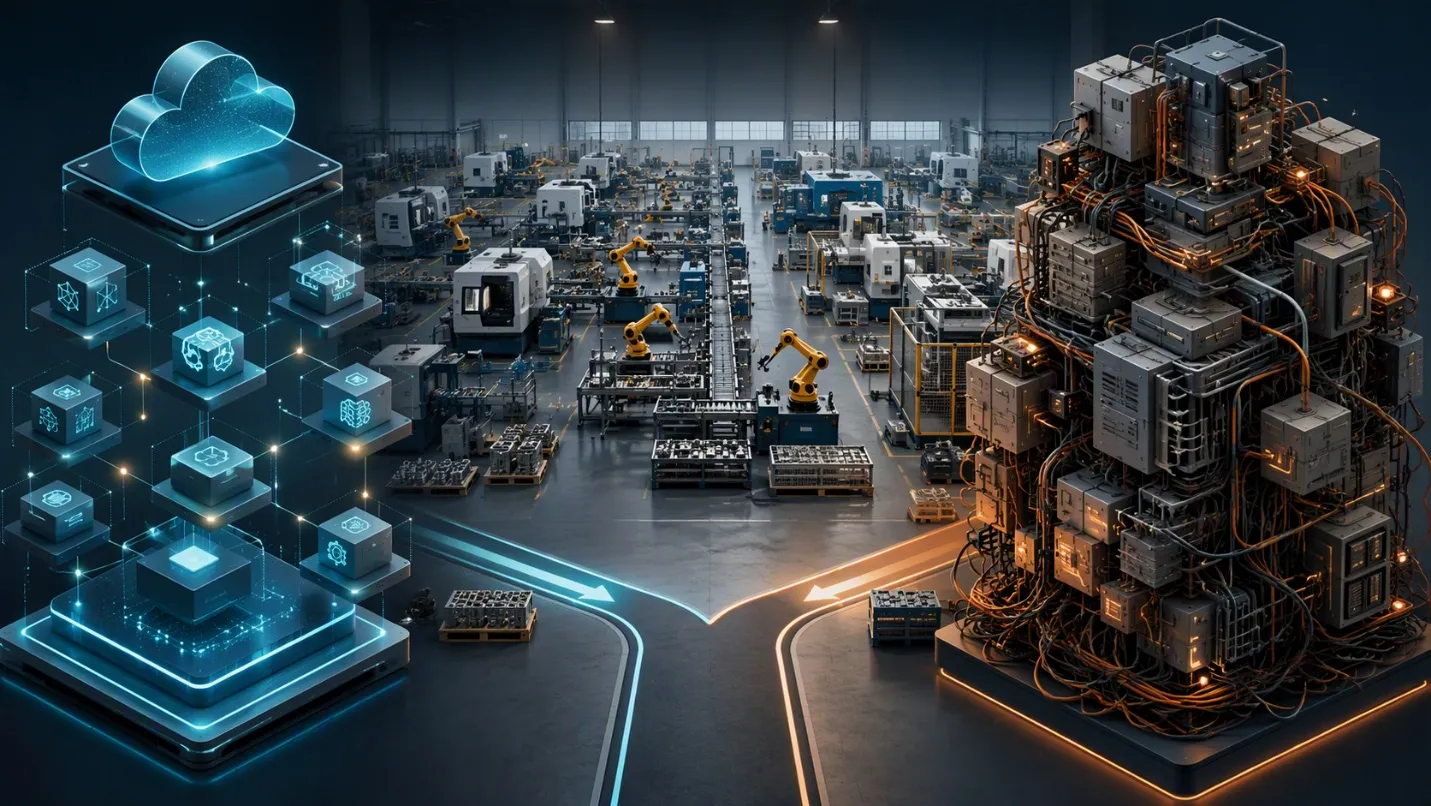
For decades, small and midsize manufacturers have faced an unsatisfying choice; rely on rigid spreadsheets and disconnected desktop tools that cannot scale, or undertake a costly, multi-year ERP implementation loaded with features they may never use.
The convergence of AI engineering, modular cloud architecture, and low-friction code generation is changing that equation. Manufacturers can now create focused operational systems designed around their own processes rather than reshaping the business around a vendor’s blueprint.
The strategic question is no longer simply whether to buy or build. It is which capabilities create competitive advantage, which can remain standard services, and how much technical ownership the business is prepared to assume.
The Case for a Custom AI-Engineered Operating Core
1. Exact Workflow Alignment
The Reality: Every manufacturing plant has its own unique shop-floor layout, routing idiosyncrasies, scrap-tracking logic, and quoting nuances. Traditional SaaS ERPs force your team to change how they operate to fit the database schema.
The AI Advantage: With modern AI coding assistants and low-code/pro-code hybrid frameworks, you can build a system that mirrors your exact shop-floor reality. If your inventory logic requires tracking raw material coils by gauge, heat number, and exact warehouse location with specific scrap-recovery steps, you can code that exact loop in days rather than waiting years for a vendor roadmap feature request.
2. Lower Marginal Cost as the Team Grows
The Reality: Enterprise SaaS pricing models penalize growth. Every time you onboard a shop floor supervisor, a quality inspector, or a shipping clerk, your monthly subscription climbs. Furthermore, you pay for complex modules (like human resources, global multi-currency ledgers, or enterprise asset management) that an SMB manufacturer doesn't need.
The AI Advantage: You own the intellectual property. Modern cloud infrastructure allows you to deploy lightweight internal tools where scaling users costs pennies on server compute rather than hundreds of dollars per user license.
3. Native AI Automation and Natural-Language Interfaces
The Reality: Retrofitting AI into legacy monoliths usually results in clunky chatbots or expensive add-on modules that don't talk smoothly to your core operational data.
The AI Advantage: When building from the ground up with modern architecture, AI can be baked directly into the data layer. Imagine shop-floor workers text-messaging or speaking updates into an internal LLM agent ("Just finished 500 units of the custom die-cut run, log 5% scrap, and move the rest to staging bay 4"), automatically updating inventory, triggering re-order alerts for raw corrugated stock, and drafting customer shipping updates instantly.
4. Modular Architecture and Faster Change
The Reality: Monolithic ERP upgrades are notoriously painful, often breaking custom reports and integrations every time the vendor pushes a quarterly update.
The AI Advantage: Modern cloud architecture relies on decoupled microservices and API-first design. If you want to swap out your shipping calculator or upgrade your forecasting algorithm, next month you replace just that small modular block without touching your core production database.
The Trade-Offs and Risks to Manage
1. Ongoing Maintenance and Technical Ownership
The Reality: When you buy a SaaS ERP, you are paying a massive subscription fee largely so someone else worries about infrastructure uptime, security patches, and database backups.
The Counter: When you build custom, you own the asset. While AI makes writing the code exponentially faster, your organization must still maintain accountability for deployment pipelines, API keys, data integrity, and minor bug fixes. (Though utilizing managed cloud environments and automated CI/CD pipelines significantly reduces this burden).
2. Scope Creep
The Reality: Because custom development makes it easy to build anything, leadership teams often fall into the trap of trying to build a universe on day one demanding CRM capabilities, advanced accounting ledgers, and fleet tracking all at once.
The Counter: Discipline is required. The strategy must follow an MVP (Minimum Viable Product) approach: laser-focus the AI engineering sprint strictly on the core bottlenecks such as inventory visibility, production scheduling, and material resource planning and integrate standard, reliable SaaS tools (like QuickBooks or standard email/payroll) for everything else.
3. Translating Shop-Floor Knowledge into System Rules
The Reality: AI is a powerful generator, but it cannot read your mind. If your team cannot clearly articulate your shop floor's tribal knowledge, material flows, and scheduling constraints, the generated code will automate bad processes just as easily as good ones.
The Counter: Success relies on treating the internal subject matter experts (your operations managers and plant supervisors) as product owners who guide the AI prompt engineering and review cycles closely.
A Practical Build vs. Buy Strategy
The strongest approach is rarely to rebuild every business function. Start with the operational workflows that differentiate the plant, such as inventory visibility, production scheduling, material planning, scrap control, or quoting and define a tightly bounded minimum viable product.
Keep commodity functions in proven services where customization offers little advantage. Accounting, payroll, email, and other standardized capabilities can remain integrated SaaS products while the custom operating core coordinates the plant’s unique data and workflows.
Questions to Answer Before You Build
- Competitive advantage: Which workflows genuinely distinguish the business?
- Ownership: Who will be accountable for security, reliability, backups, integrations, and the product roadmap?
- Scope: What is the smallest release that solves a measurable operational bottleneck?
- Data readiness: Are material flows, routing rules, exceptions, and tribal knowledge documented clearly enough to automate?
- Integration: Which existing systems should remain, and what data must move between them?
Conclusion
AI-assisted engineering has made custom operational software far more accessible, but faster development does not eliminate the need for disciplined product ownership. For SMB manufacturers with distinctive processes and a willingness to manage a focused digital asset, an AI-powered operating core can provide better workflow fit, lower marginal user costs, and faster innovation than a broad enterprise suite.
The winning principle is simple: build what differentiates the plant, integrate what does not, and expand only after the first operational problem is measurably solved.
All blog posts